
Augustin Dupre's American Masterpiece
Betts-615, Adams-Bentley 15 : Silver. Original 1783 Paris Mint striking. 47.5 mm. 817.7 grains
Rich in symbolism and directly tied to Benjamin Franklin, the LIBERTAS AMERICANA medals are one of the most storied remembrances of the American Revolution.
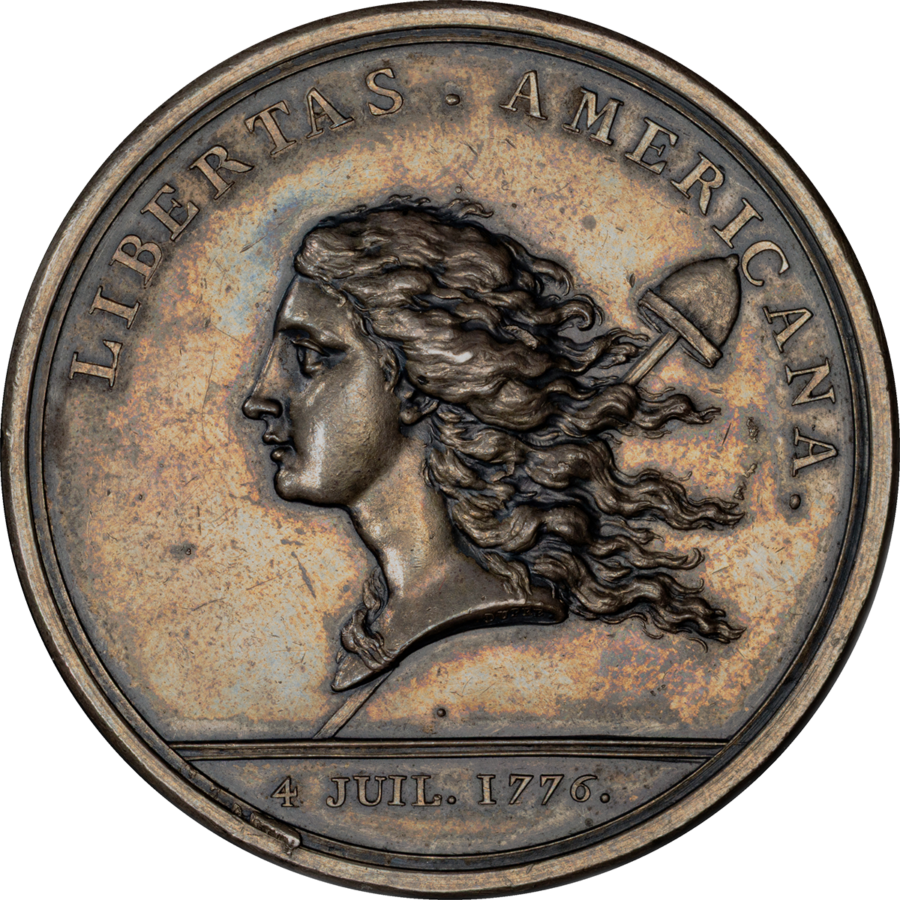
The obverse shows a young personification of Liberty in high relief, her hair flowing behind her as if in motion, and a pole over her right shoulder topped by a Phrygian cap of liberty. Above is written LIBERTAS.AMERICANA., below, 4 JUIL.1776., the date of our Declaration of Independence, which includes the bill of grievances against the King of Great Britain.
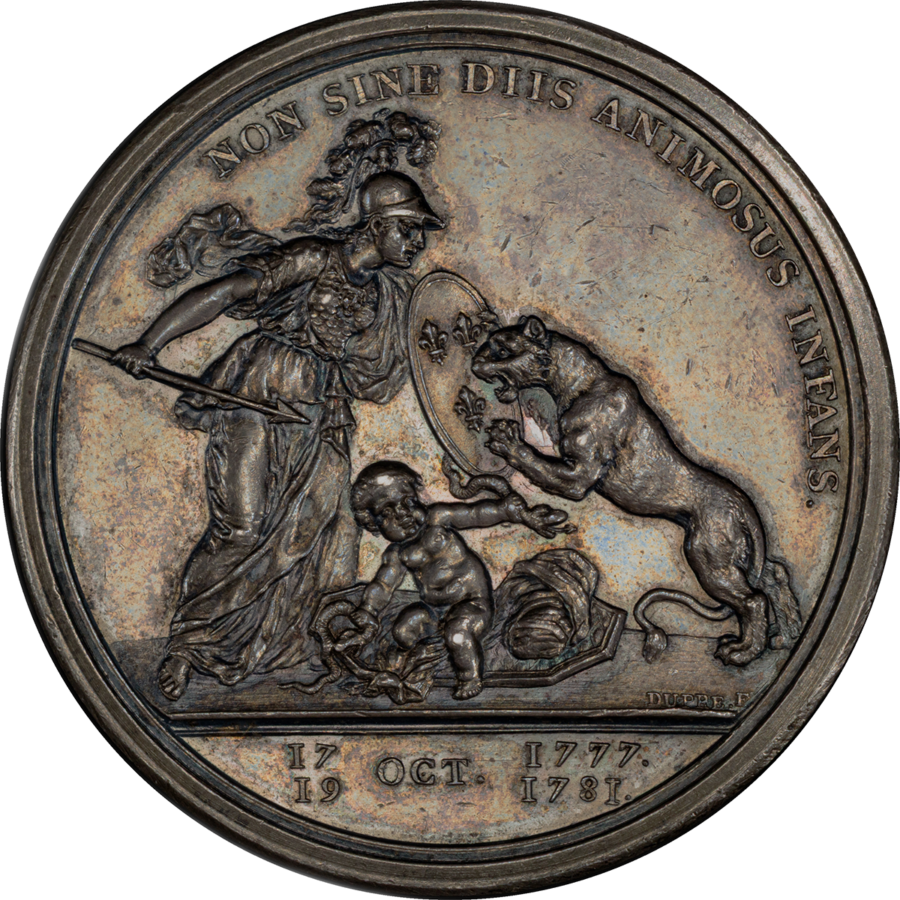
On the reverse above, NON SINE DIIS ANIMOSUS INFANS, translated by Adams and Bentley as “The courageous child is not without the aid of the gods”. In the exergue below are listed two dates, 17 Oct. 1777 and 19 Oct. 1781, the dates of surrender of the British forces under John Burgoyne to Horatio Gates at Saratoga, and under Charles Cornwallis to George Washington at Yorktown. At the center is a young America as the infant Hercules, rising from a battle shield as his crib, and strangling two snakes as the British armies defeated at Saratoga and Yorktown. America as Hercules is protected at left by France as a militaristic Minerva, shield in her left hand and sword in her right, fending off the British lion shown with its tail between its legs. There is no subtlety here.
Benjamin Franklin, United States Minister to France under the Continental Congress, conceived the LIBERTAS AMERICANA medals as a remembrance of the victories at Saratoga and Yorkville, and as a appreciation to the important role that France played in the success of a young America. In concert with Esprit-Antoine Gibelin of the Académie royale de peinture et de sculpture (Royal Academy of Painting and Sculpture), Augustin Dupré, engraver, and the Monnaie de Paris, Franklin’s inspiration became a reality.
The often quoted Adams-Bentley Census includes 22 original silver Libertas Americana medals (1). However, Adams and Bentley also note that Franklin paid for 20 silver medals on April 4, 1783, another 20 on April 30, and an estimated 15 more on July 2. Furthermore, additional small strikings were made until as late as 1791, leading to their all-in estimate of 60 struck in silver, 200 or so in bronze, and two in gold. My own census currently includes 27 silver, and I expect that a more thorough search will yield a population of about 40 in all. Nevertheless, this remains one of the most important objects in all of Early American numismatics, the model for many of our most prized coinage issues, and yet is still available at an approachable price level.
PCGS #56921682
Provenance
Stack’s Bowers, August 2025, lot 1016 at $144,000
- Adams, John W. and Anne E. Bentley, Comitia Americana and Related Medals (2007), 190